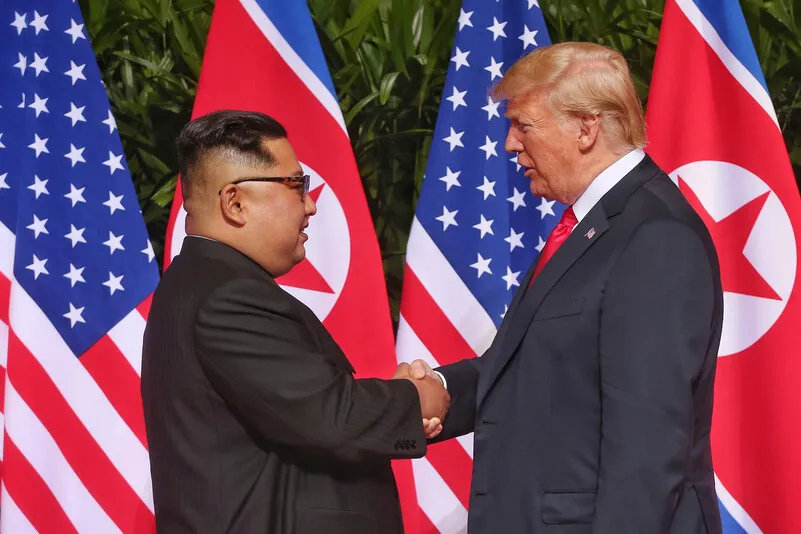
North Korean leader Kim Jong Un traveled to China on 24 October, meeting Wang Huning, the fourth-ranked figure in China's political hierarchy and chairman of the Chinese People's Political Consultative Conference, according to 한겨레. The visit has revived speculation about a possible resumption of North Korea–United States summitry, but 한겨레 reports that the trip's character and the current state of North Korea–U.S. contacts make it hard to read as preparation for such a meeting.
Attention focused on Kim's stop in Dandong in part because of precedent. Before the first North Korea–U.S. summit in Singapore in June 2018, Kim visited China twice to consult with President Xi Jinping, and he met Xi again in January 2019, ahead of the February summit in Hanoi that year. That history led to suggestions that the 24 October trip could signal a reopening of dialogue with Washington.
Why it matters
Any Trump–Kim meeting would carry weight for security on the Korean Peninsula and for the wider region, and the question of whether one can be arranged before the year ends has become a test of how much diplomatic traction remains between the two sides. The reporting suggests the answer, for now, is very little.
Donald Trump is due to attend the Asia-Pacific Economic Cooperation (APEC) summit in Shenzhen, China, on 18–19 November, and some had floated the idea that he could meet Kim around that gathering. The latest assessments from officials in Washington and Seoul point the other way.
A visit with a different shape
한겨레 notes that this trip differs from Kim's earlier China visits in several respects. He did not hold a summit with Xi, meeting Wang instead. The visit was completed in a single day, and its emphasis fell on touring an automobile factory and on expanding economic and trade cooperation, including via the New Yalu River Bridge. On that basis, the outlet reports, there is insufficient evidence to link the trip to advance coordination for a North Korea–U.S. summit.
Coverage from other South Korean outlets pointed in the same direction. 세계일보 reported that prospects for a North Korea–U.S. summit are fading, citing a U.S. expert who put the odds at under 10 percent. 경향신문 reported that South Korean and U.S. authorities judge a meeting between Trump and Kim within the year to be unlikely. YTN framed the question around Kim's silence, including amid rumors about his health, and asked whether a Trump meeting is out of reach for this year.
MBC 뉴스, citing Reuters, reported on 23 October that multiple South Korean and U.S. officials see a very low chance of a Trump–Kim summit before the end of 2026. According to that reporting, Washington sounded out the possibility of a meeting but received no answer from North Korea, and there is too little time to prepare before the APEC summit in Shenzhen on 18–19 November.
Trump himself has shifted to a more cautious posture on the question. On 19 October he told reporters that he maintains a good relationship with Kim but added that he is not sure who is requesting a meeting, according to the same reporting.
Ankit Panda, a senior fellow at the Carnegie Endowment for International Peace, assessed the probability of a summit on the margins of APEC at less than 10 percent, 세계일보 reported. He argued that North Korea is seeking a signal of significant policy change from the United States as the price of agreeing to talks.
A surprise cannot be ruled out entirely
The possibility of a sudden meeting has not been dismissed outright. Michelle Park Steel, the U.S. ambassador to South Korea, said at an event in Seoul on 21 October that the timing of any summit is hard to predict, but that if one is arranged it would be announced a day or a few days beforehand, according to the reporting.
For now, the public record offers little to suggest that preparations are under way. Kim's China schedule centered on economic themes and a lower-ranking interlocutor than Xi, while Washington's overture, as described by officials, has gone unanswered.
What to watch: whether North Korea responds to the U.S. contact before the Shenzhen summit on 18–19 November, and whether either side signals a change in position in the days around that meeting.